The main book I used to create a structured training plan was Training for the New Alpinism by Steve House and Scott Johnston:
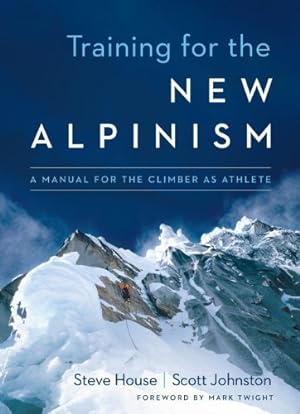
The main training principles from this book are:
- Continuity - consistent training trumps "epic" workouts
- Gradualness - progressive overload
- Modulation - adaptations happen while you rest
Taking into account that I live in a very flat area, my training revolved around 3 main axes for this trek:
- Aerobic base: Two running sessions per week; one long (typically > 8km) and slow (nose-breathing throughout), one short (typically 5km) and fast (typically < 5min/km pace for me)
- Weight training: Typically two sessions per week with a split between the 3 main lifts (squats, deadlifts, bench press)
- Some form of weighted uphill training (with a backpack) - typically using a box step, an incline treadmill, or (when lucky) hiking
Below you’ll see that my week also included climbing and football, which were things I was already doing and didn’t stop during this period.
Here’s the training schedule I followed in the 4 months leading up to the trek.
Weekly structure
| Mon | Tue | Wed | Thu | Fri | Sat | Sun | |
|---|---|---|---|---|---|---|---|
| Morning | Rest | Rest | Rest | Rest | Rest | Loaded uphill carry | Long slow run |
| Afternoon | Weightlifting Squat + Deadlift |
Rest | Weightlifting Bench + Hammer curls |
Rest | Rest | Rest | Rest |
| Evening | Football | Bouldering Flash practice |
Short fast run | Bouldering Projecting |
Bouldering Perfect repeat & endurance |
Rest | Bouldering Projecting |
16-week progression
The plan runs in 3-week progressive blocks followed by a deload recovery week, where volume and load drop by roughly 40–50% to let adaptations consolidate.
| Week | Long slow run (km) | Fast run (min/km) | Uphill carry (m) | Bench (kg) | Squat (kg) | Deadlift (kg) |
|---|---|---|---|---|---|---|
| 1 | 7 | 4:45 | 600 | 90 | 110 | 120 |
| 2 | 8 | 4:40 | 700 | 90 | 110 | 120 |
| 3 | 9 | 4:35 | 800 | 90 | 110 | 120 |
| 4 deload | 4.5 | 4:30 | 400 | 50 | 60 | 70 |
| 5 | 10 | 4:30 | 900 | 95 | 120 | 130 |
| 6 | 11 | 4:25 | 1000 | 95 | 120 | 130 |
| 7 | 12 | 4:20 | 1100 | 95 | 120 | 130 |
| 8 deload | 6 | 4:30 | 550 | 60 | 70 | 80 |
| 9 | 13 | 4:15 | 1200 | 100 | 130 | 140 |
| 10 | 14 | 4:10 | 1300 | 100 | 130 | 140 |
| 11 | 15 | 4:10 | 1400 | 100 | 130 | 140 |
| 12 deload | 7.5 | 4:30 | 700 | 70 | 80 | 90 |
| 13 | 15 | 4:10 | 1500 | 100 | 130 | 140 |
| 14 | 15 | 4:10 | 1600 | 100 | 130 | 140 |
| 15 deload | 7.5 | 4:30 | 800 | 60 | 70 | 80 |
| 16 deload | 7.5 | 4:30 | 800 | 60 | 70 | 80 |
If you have access to hills/mountains, your training could (should!) look quite different, with more emphasis on hiking outdoors with a moderately heavy backpack. I would advise you to skip the box-step/incline-treadmill workouts completely (except in absolutely horrendous weather), and even the running sessions (except maybe the long, slow one). Hiking with a backpack (and hiking boots!) is the most specific training you can do. Even long walks on flat ground with a backpack will be beneficial to get used to the type of strain you can expect on the trek.
If you’d like to test your fitness, go to this page to find some custom-built online apps.
If you’d like to check your weightlifting strength compared to standards based on weight and age you can go here